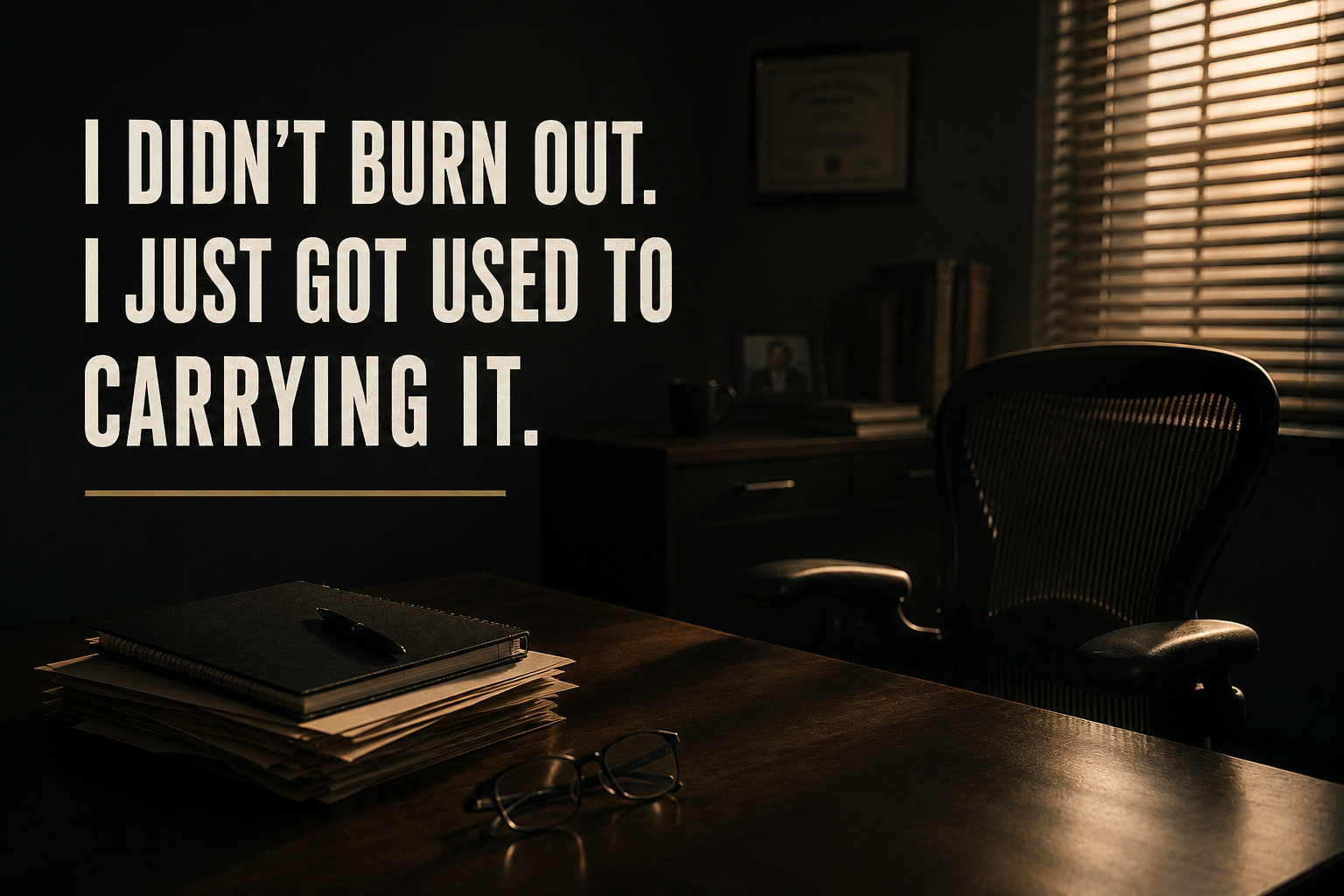
I Didn't Burn Out. I Just Got Used to Carrying It.
For a long time, I didn't think wellness applied to me.
I believed in it. I funded it. I encouraged it. I signed off on time-off requests and trainings and told people, truthfully, take care of yourself first. I just didn't include myself in that sentence.
Nothing was on fire. The wheels were still turning. Emails were answered. Crises handled. Decisions made. From the outside, it looked like leadership. From the inside, it felt like weight, manageable, familiar, unnamed.
That's the thing about this kind of depletion. It rarely announces itself. It just quietly becomes the background.
The Pension Moment
I was looking at my pension numbers one afternoon. How far away I was. How much I'd get monthly when I finally stepped away. And here's the thing—it wasn't enough. Not for what I'd given. On paper, sure, it looked like a respectable number. But when I calculated what that actually meant for my life, for maintaining anything close to my current reality... the math didn't add up to the sacrifice.
I'd worked for decades. Missed family dinners and weekends and moments I'll never get back. And the return? It felt disproportionate. Not because I expected to get rich, but because in that moment, staring at those numbers, I couldn't shake the feeling that I'd traded too much of myself for too little in return. That's when the exhaustion hit—not just physical tiredness, but the kind that makes you question the entire equation.
That moment crystallized something I'd been avoiding for years. The passion had shifted. New management brought in new approaches—some that didn't make sense to me, but I had little choice in the final decisions. The monotony was real. It felt like we were all just going through the motions without real momentum.
Looking back, I was projecting my own flatness onto everything around me. When you're depleted, it's hard to see possibility anywhere.
When Leaders Become Shock Absorbers
Research shows that leaders perform emotional labor with the same frequency as front-line service workers who have to deliver "service with a smile." You're absorbing tension, calming storms, suppressing your own emotions for organizational good. This containment work is invisible... and exhausting.
The job rewards containment. Calm is currency. Composure is competence. So you learn to regulate, compartmentalize, swallow reactions that would be human but inconvenient. You learn to be steady.
That skill keeps organizations upright. It also keeps leaders from noticing when they're depleted.
I came into this profession with expectations—not naïve ones, but hopeful ones. I expected stress, conflict, long nights, hard calls. What surprised me was how much leadership energy goes into managing the human dynamics that exist in every organization. The unspoken tensions. The interpersonal navigation. The emotional currency of keeping teams functional.
Some days, that work felt as important as any tactical decision I made.
Leadership in any hierarchical profession means you're always reading the room, sensing shifts, noticing what's said and what isn't. That awareness is part of the job. But it's also exhausting in ways that don't show up on a task list.
And when you're the leader, you don't just notice it—you carry it.
The Difference Between Burnout and This
I kept showing up. Going through the motions. But nothing new was happening. I found myself surrounded by people who'd learned it was easier to agree than engage—a pattern I've seen across many departments over the years.
This wasn't burnout in the dramatic sense. There was no collapse. No breakdown moment. Just a narrowing.
Less patience. Less curiosity. More urgency.
Still effective, but flatter. Like leadership in grayscale.
Current data shows that 71% of leaders report significantly higher stress levels since stepping into leadership roles. But here's what's interesting: Deloitte's 2025 research reveals that mental fatigue, cognitive strain, and decision friction are now the leading indicators of burnout—surpassing workload volume for the first time.
It's not about working too many hours. It's about the loss of curiosity, patience, and genuine engagement. The erosion happens so gradually that you don't notice you're operating at 60% capacity until someone points it out... or until you're staring at pension numbers wondering if it was worth it.
The Moment Everything Clarified
The breaking point came when I realized the gap between what we were teaching about wellness and what was actually happening behind closed doors. It went against everything we'd been working toward. I thought we were building something authentic.
That was the turning point. I realized that despite my best efforts, organizational culture has limits. You can create conditions, but you can't force depth. Some people engage with the work at a surface level, and that has to be okay.
I'd been working to create culture first—policies came after. The culture in my mind was building something real and authentic. I was deeply invested in that vision. Today, I channel that investment differently. I'm still passionate about the profession as a whole, about the changes the industry needs to make... but I've learned to separate my identity from any single workplace.
A supervisor once told me: "You can't be friends with your employees." I disagreed at the time. Over the years, I've come to understand what he meant—not that you can't care deeply or build trust, but that the relationship has boundaries. The hierarchy matters. The role creates distance, whether you want it to or not. That doesn't mean leadership has to be cold... it just means it has to be clear-eyed.
The Permission Paradox
I wanted everyone to be at a high standard. I learned through therapy that it was okay for others to have a lower standard. My standard is probably dopamine-driven—strive to be the best at everything. I've watched people approach the job differently than I would, with different priorities and different measures of success... and I've had to learn to let people operate at their level.
That tension—between holding standards and accepting reality—is something I'm still navigating.
Here's what I've realized: I gave my team permission to operate at their own level. But I never gave myself that same permission. I'm still holding myself to this "be the best at everything" standard. The gap between what I expect from myself and what I accept from others... that's where the exhaustion lives.
That's why I'm doing things like podcasts and building a business—not as escapes, but as places where that energy can flow productively. Where I can create something that feels aligned with who I actually am, not just the role I'm filling.
Research confirms what I've lived: when leaders give themselves permission to not be okay, it transforms not just their own experience but gives their team genuine permission to be human. The higher up someone is in the hierarchy, the less "permission" they tend to feel they have to show vulnerability.
This is where wellness stops being theoretical.
It's not yoga mats or policies or posters. It's whether leaders give themselves permission to be human before modeling humanity. Because people don't follow what we say. They follow what we tolerate. They watch what we normalize.
They notice who never disconnects. Who jokes about exhaustion like it's currency. Who absorbs everything and calls it strength.
I did that too.
What Hiring Reveals About Depletion
Hiring makes all of this louder.
On paper, hiring is rational. Structured. Objective. In reality, it's closer to intuition mixed with risk management. You interview. You check boxes. You imagine how someone will move through rooms that already carry history.
You ask yourself questions you'll never say out loud: Will they steady the culture or fracture it? Will they add capacity or add noise? Will they need the spotlight or be okay doing the work?
When you're operating from depletion, you're not looking for the best person. You're looking for the person who won't add to your burden. That's the honest truth.
I've always leaned toward the educated, not because degrees create good officers, but because education often signals exposure. To disagreement. To feedback. To finishing something hard without quitting halfway through. It's not foolproof. It's a filter.
Sometimes the right call is to wait. To be intentional. To recognize that hiring well matters more than hiring quickly, even when that decision feels uncomfortable.
In municipal environments, there's often pressure to promote from within, to follow succession plans that prioritize tenure over capability. I've struggled with that model, watching positions filled based on who's next in line rather than who's actually ready or right for the role.
Finding the Way Back
I started to get my mind back in check. Step away a bit. Work the schedule many other chiefs work. I may even pick up golf this summer.
My mind and soul need to be fed, and that doesn't come from within those walls. There are some who still seek my counsel - those are the conversations that matter. We talk about leadership, education, financial planning, growth. But I've accepted that not everyone is wired for that depth of engagement, and that's their choice to make.
When I talk to those few who are still curious, still growing, I tell them what I wish someone had told me twenty years ago:
Focus on learning and improvement. Keep friendships outside of the profession. Don't consume yourself with the work—let your work speak for itself. Integrity is nonnegotiable. Make time for family, and when the profession starts to intrude on that, look for balance and pursue it relentlessly.
Family is more important than colleagues. Take time after the tough calls to center yourself. Get coaching along the way from someone you trust. Find mentorship.
These aren't radical transformations. They're small shifts. One percent better every day. The kind of incremental changes that compound over time into a different kind of leadership presence.
What I'm Still Learning
I didn't wake up broken. I woke up one morning realizing I couldn't remember the last time I'd felt unburdened. Not rested—unburdened. The kind of tired that doesn't live in the body. It lives behind the eyes.
Nothing was "wrong." So I kept going.
That's when I realized this wasn't a time-management problem. It was an identity problem. When leadership becomes the only version of yourself that gets oxygen, there's no room left to recover. You're always on. Always available. Always carrying the next issue before the current one has landed.
That's not resilience. That's endurance.
And endurance always sends a bill.
What I'm still learning—slowly—is how to lead without disappearing into the role. How to care without absorbing everything. How to stay present without becoming the container for everyone else's unresolved tension.
There's no framework for that. No checklist. Just awareness.
The podcast, the business, the eventual golf game—these aren't escapes. They're places where I get to tap into my creative mind, talk, be there with my voice and thoughts. They're spaces where the grayscale version doesn't have to show up.
Because the most dangerous moment isn't when things fall apart.
It's when everything looks fine—and you don't realize how much of yourself you've been holding back just to keep it that way.
Have you noticed the grayscale creeping in? What version of yourself are you holding back to keep everything looking fine?
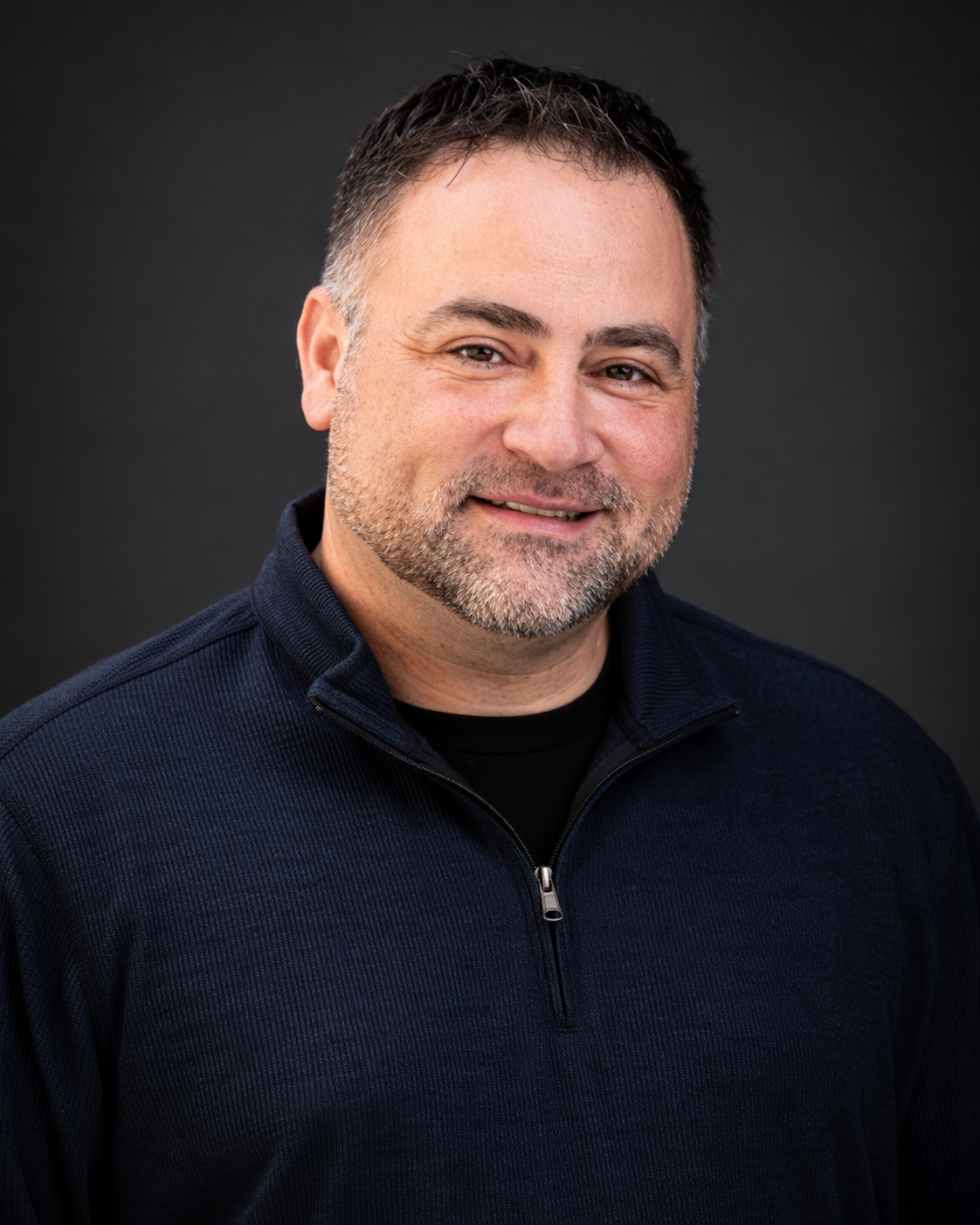
Host | Maine Responder
I've spent much of my adult life in work that carries responsibility for other people. Along the way, I became less interested in having all the answers and more interested in asking better questions.
Maine Responder is where I work through those questions.
Through conversations, stories, and reflections, I explore leadership, human performance, purpose, and the work that shapes who we become.
I don't claim to have the answers. I'm simply curious enough to keep asking the questions.
If you'd like to think through them with me, welcome.
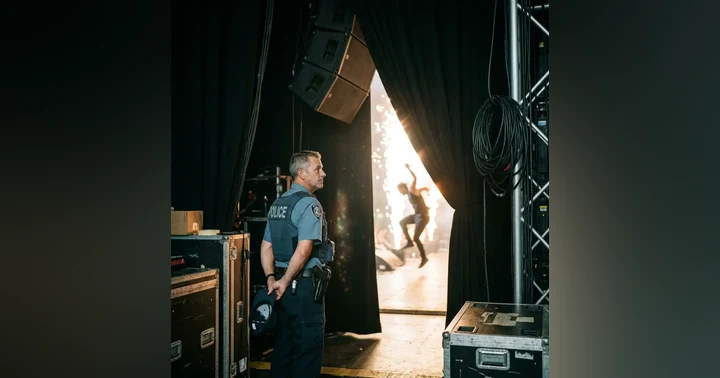
The Backflip Nobody Saw: What a Pop Concert Taught Me About Mastery and Drift