Three Shifts: What Every Call, Every Day, Every Year Is Doing to You
Years ago, a chief I respected used to remind us, "You apply for this job every day."At the time, I understood it as an obligation to earn the privilege of wearing the badge. As time went by, I realized that applying for the job means something deeper. Every day, we reapply not only to the profession we serve, but to the person we're becoming. We apply through our work, through our mindset, and through the character we carry home at the end of every shift. Think about your morning routine. You arrive, pull into the parking lot, my guess is the same spot you usually take, and sit there for the few minutes that may be the only ones that are truly yours all day. You walk in. The locker room smells the same as it did yesterday. Your vest is where you left it. You check your gear the way you've done a thousand times. I am a small town chief now. I do not work the grind the way I used to, and I will not pretend I do. My shift looks different, and that space has given me something I did not have when I was in the middle of it: perspective. And what I notice, watching the officers I'm responsible for, is something I wish someone had said to me a long time ago. Every single shift changes you. Not just the twelve hours you're on duty, but every difficult conversation, every critical incident, every new officer you mentor, every success and every failure. They all leave a mark. Over the course of a career, that accumulation becomes something. We spend a lot of time asking what the job is doing to us. I think there's a question we ask less often, and it may be the more important one.
I have come to believe every shift is shaping you. The profession gives you something. You leave something behind. Whether you notice it or not, every shift is shaping you.
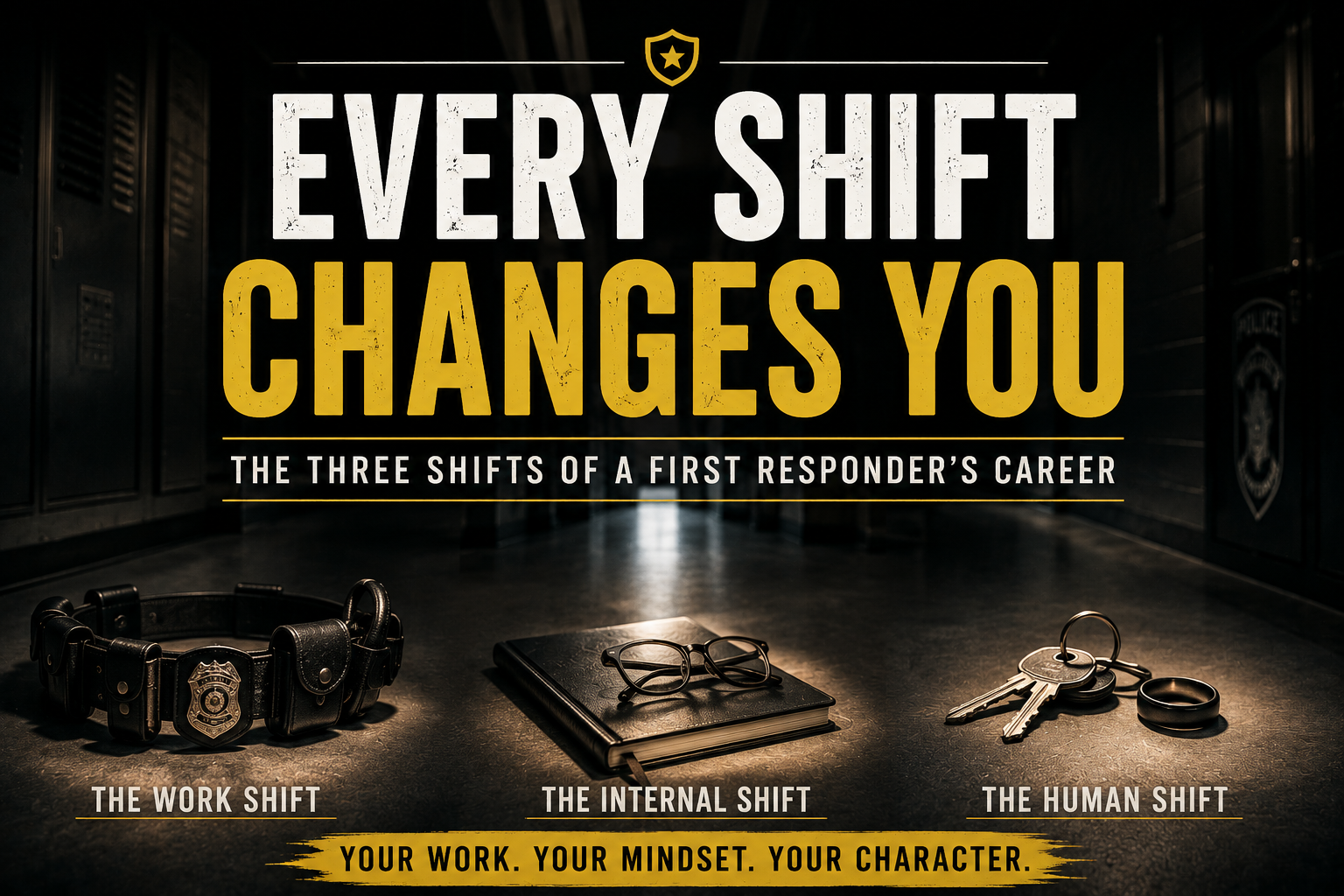
The Work Shift: What Moves Between You and the Profession
The most visible shift is the one you clock in and out of: the work itself. And this profession offers things that are genuinely hard to find elsewhere. It gives you experience that cannot be replicated in a classroom and competence earned one call at a time. It offers a perspective that only comes from walking with people through the worst and sometimes the best moments of their lives. It teaches lessons no classroom ever will. In a small department, things may be more concentrated. You know the people you are responding to. You went to school with their kids, or they went to school with yours. The work is personal in a way that's both a benefit and a weight, and most of the officers I know wouldn't trade it. The work shift takes, as well. Research shows that organizational stressors, poor leadership, lack of institutional support, and the grind of workplace dysfunction often cause more psychological harm than the critical incidents officers are trained to handle. The cumulative burden of everything else wears people down over time. I see this in myself now, though I didn't fully understand it before. There were stretches when I was absorbing more than processing, when the job was taking, and I was not attentive to what I was giving back or what I was losing in the exchange. I did not have the words for it then. I just knew something was moving, and not entirely in the right direction. So the question worth sitting with is this: what are you doing with what the work is giving you? Are you learning the lessons, the perspective, the hard-won competence? Or are you accumulating stress without processing what you are learning from it? On the other side of the exchange: what are you bringing to the profession? Your best effort? Your integrity? Your sincere curiosity about how to do this better? Or have you already quietly checked out, going through the motions of a job you stopped believing in somewhere along the way? I ask myself that second question differently now. Leadership changed my role. It did not change the exchange. As a chief, what I give the profession looks different than what it used to. It looks like the culture I'm building, the example I'm setting, the way I treat the people who work for me. That is the weight that I carry differently than I did when I was working shifts. But it's the same exchange, just at a different level.
The Internal Shift: What's Happening Inside the Uniform
The part some officers miss is this: the work not only develops your skills. It shapes your thinking, self-talk, and identity. Long before anyone notices a change in your performance, your thinking has already begun to change. Two officers can handle similar calls, face similar organizational pressures, and walk away as fundamentally different people. The difference is not the job. It is what happens internally, in the gray area between what the shift leaves us with and what the officer does with it. Looking back, I see the moments when my internal shift was happening, when my thinking and the job were rewritten by experience. Some of it was good. Some of it wasn't. And the difference, often, came down to whether I was being intentional about what I was feeding my mind or just letting it absorb whatever the job threw at it. There is a framework worth knowing here. Researchers call it Psychological Capital, or PsyCap, and it's built around four resources that officers can actively develop rather than simply hope to have: Hope, Efficacy, Resilience, and Optimism. They are not personality traits. They are resources. Resources that can be strengthened. James Clear writes that every action is a vote for the person you want to become. Romans 12:2 arrives at the same place: be transformed by the renewal of your mind. Not by willpower alone, not by simply trying harder, but by changing what you pay attention to, what you allow to take root, what you return to when the shift gets hard. Is this work making you more compassionate or more cynical? More intentional or more reactive? I don't ask that to judge anyone. However, I've watched both trajectories play out over the course of careers, and the direction is rarely dramatic. It happens one shift at a time.
The Human Shift: The Person Being Formed Beyond the Badge
Eventually every officer discovers something. Policing is only a chapter. A significant one, maybe the defining one, but still a chapter in a longer story that may include marriage, kids, promotions, failures, losses unrelated to the job, health scares, and the retirement you're either dreading or quietly counting down to. These experiences don't interrupt your life. They become part of the person you're becoming. They shape the person your family lives with after the badge comes off. This is where moral injury becomes important to understand, and where I think small-town policing carries a particular burden that doesn't always get named. Moral injury isn't the same as trauma, though the two often overlap. Moral injury is based in a violation of what you believe to be right. It happens when you witness something that conflicts with your deepest values, when the organization you trusted betrays that trust in a way you can't reconcile, when you're forced to make a decision in a gray area, and you're still carrying it years later. Those experiences come across differently, especially in small-town policing. When you work a fatal accident, and you know the family. When you arrest someone you went to church with, or see regularly at the school pickup line. The professional and the personal do not cleanly separate here, as they might in a larger department. And it is heavy in ways that can reshape who you are if you're not paying attention. Post-traumatic growth research tells a more hopeful story, though. Adversity, including moral injury, can lead to genuine positive development when it is processed intentionally and with meaning-making. Growth happens when people ask the right questions about what their experience is forming in them, and when they have the support to sit with those questions honestly. As a chief, I think about that often. I cannot always give my officers more resources, better pay, or an easier job. I can commit to taking my own advice and to relentlessly working to create an environment where reflection is normal and where asking hard questions about the internal experience of this work is a mark of strength rather than weakness. That might be the most important thing a chief can do. The question for the life shift is the simplest and the hardest: what kind of person is this experience forming? Not just what kind of officer. What kind of person.
Where the Three Shifts Meet
These three shifts do not stay separate. They bleed into each other, and they compound over time in one direction or the other. I have watched it happen in both directions. A cynical officer, one who stops asking what the work is giving him and only feels what it is taking from him, tends to become a cynical supervisor. A cynical supervisor tends to come home as a cynical husband, a distant father, someone who is present in body but otherwise checked out. And then one day he retires, and he is not sure where the years went or why the people he loves seem relieved that he is finally home. That is the closing point: the shift does not end when the uniform comes off; it follows you home, and it becomes the life you live, not just the job you work. In contrast, a curious new officer, one who stays open to what the work is teaching, tends to become a lifelong learner. A lifelong learner tends to become a leader people actually want to follow, not because of rank but because of who they are. That person tends to become the one younger officers still talk about years later, the one who shaped how they thought about the job and about themselves. Same profession. Same shifts. Completely different outcomes. And the difference, often, comes down to whether someone was paying attention to what was happening inside them, not just around them. From where I sit now, that's the thing I most want the officers in my department to understand. Not because I have it all figured out. But because I have been on both sides of that fork in the road, and I know which direction is worth choosing. You apply for this job every day. Through your work, your mindset, and the character you carry home.
Three Questions Before You End Your Shift
I want to close with something practical, because I think this kind of reflection has a reputation for being motivational and vague, and that's not what I am after. Before you leave every shift...Ask yourself three questions.
What did this shift give me? Not just what it took. What did it teach you? What perspective, lesson, or experience will make you better tomorrow than you were today?
What did I give? Did you bring your best effort, your integrity, your professionalism, or your compassion—or did you simply get through another day?
Who am I becoming? Not who you hope to become someday, but who you are becoming right now through the choices you make, the habits you reinforce, and the person you're practicing to be. If you ask those questions long enough, they stop feeling like an exercise in reflection and become a source of direction. Every shift is already shaping you. The decision to be made is whether you will participate in that process intentionally. We spend our careers investing in the people we serve. Make sure you are making the same investment in yourself. Because one day, the greatest legacy of your career won't be the work you did—it will be the person you became.

Host | Maine Responder
I've spent much of my adult life in work that carries responsibility for other people. Along the way, I became less interested in having all the answers and more interested in asking better questions.
Maine Responder is where I work through those questions.
Through conversations, stories, and reflections, I explore leadership, human performance, purpose, and the work that shapes who we become.
I don't claim to have the answers. I'm simply curious enough to keep asking the questions.
If you'd like to think through them with me, welcome.
The Backflip Nobody Saw: What a Pop Concert Taught Me About Mastery and Drift