When "Work Family" Language Backfires in First Responder Culture
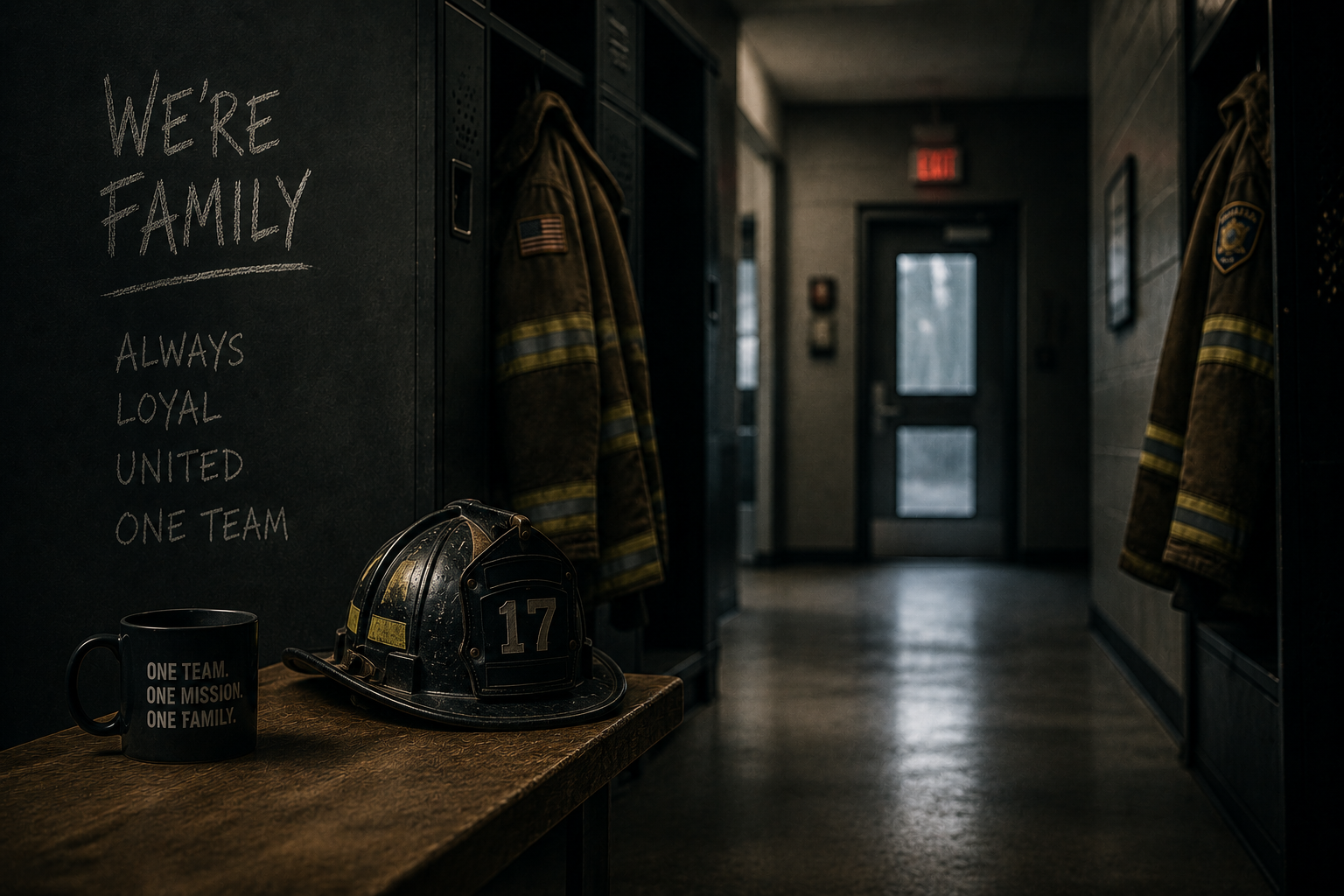
There's a pattern that plays out in first responder units across the country. Team members talk about their unit being a family, and many people feel something real... a sense of belonging that makes the hard days easier. The language creates an expectation that everyone has each other's backs no matter what, that the bond shared is somehow deeper than just colleagues doing a job together.
But then reality hits. Officers discover that team members they trusted have been talking behind their backs. In their face, those colleagues are all about the mission and wellness. Behind closed doors, it's a different story. These moments shatter trust and teach a razor-sharp lesson about how workplace dynamics operate differently than the "family" label suggests.
Another common scenario: during a disagreement or conflict that requires mediation, someone pulls the "we're a family" card as if it's a magic reset button that erases everything. The person hearing it can often predict it's coming, and there's something hollow about the approach—an assumption that invoking family language will smooth over legitimate professional conflicts.
These moments reveal something important: the family metaphor might be doing more harm than good, especially for those who take it seriously. Some officers genuinely buy into the concept, investing emotionally at a level the workplace simply cannot reciprocate.
The Problem With Borrowing Family Language
Here's the core issue: when professionals call their work colleagues "family," they're setting themselves up for a kind of hurt that's hard to shake. Many believe the job is supposed to have that level of camaraderie and trust. The reality? It's a job. And that's okay... but only if organizations are honest about it.
The research backs this up in ways I didn't expect. In the Harvard Business Review article "Your Company Is Not a Family," Reid Hoffman and Ben Casnocha make a critical distinction: in real families, you can't fire your children for poor performance. The unconditional nature of family bonds simply doesn't translate to workplaces where performance and results matter. When organizations borrow family language, they create misunderstandings about the nature of the relationship.
Another HBR article, "When Work Feels Like Family, Employees Keep Quiet About Wrongdoing," reveals something even more troubling. Researchers found that employees who work in family-like cultures are less likely to blow the whistle on a colleague's misbehavior. Think about that in the context of first responders... when people are told they're family, they're less likely to report the very behaviors that erode trust. The facade of loyalty becomes more important than accountability.
Joshua Luna's HBR piece "The Toxic Effects of Branding Your Workplace a 'Family'" identifies how organizations mask their shortcomings and instill a false sense of belonging by touting family culture. This directly connects to what happens when someone pulls the "we're a family" card during conflicts... it's an attempt to shortcut accountability with emotional manipulation.
Words matter. How our brain reacts to the words we use is just as important as the intentions behind them. When you hear "family" attached to your coworkers, your brain starts creating expectations that a work relationship simply can't deliver on. It minimizes what family really is, and work people will never live up to that. It also creates a false sense that these people are family, which sets an organization up to fail emotionally.
Words matter. How our brain reacts to the words we use is just as important as the intentions behind them. When you hear "family" attached to your coworkers over and over, your brain starts creating expectations that a work relationship simply can't deliver on. It minimizes what family really is, and work people will never live up to that. It also creates a false sense that these people are family, which sets an organization up to fail emotionally.
What Family Really Means
Some agencies may genuinely cultivate a family-like feeling, and that works for them. But in order to maintain healthy relationships across the board, there needs to be some distance. Some wellness programs aren't recognizing this need and should be more careful about what's really happening when spouses get together, and the lines blur even further.
Family is the people who are there when the uniform comes off. Family is the kid waiting for you at the dinner table, the spouse who knows your real name before you had a badge number. Family is unconditional in ways that work relationships fundamentally cannot be.
When professionals use "family" for both contexts, something dangerous happens. Brains are taught to treat them as equal, and they're not. The moment someone retires, the machine rolls on and their phone stops ringing. This pattern repeats across agencies. Even when a colleague gets hurt and is out on workers' comp for a while, people reach out less.
These are jobs. They're noble, meaningful, important jobs... but the shadow box on the wall with pieces of metal won't be there to wipe your ass when you're aging.
The Psychology Behind the Hurt
Let's look at the psychology for a second. When workplace trust is violated, especially after being told "we're family," the psychological damage mirrors intimate betrayal. Research on workplace betrayal reveals that when expectations are violated through lying or exploitation, employees feel betrayed, which lowers trust levels and job satisfaction and increases turnover intentions.
The pain officers feel when team members maintain a facade of loyalty while operating differently behind the scenes... that's a documented phenomenon. Betrayal undermines the sense of safety that people derive from close relationships, creates mistrust in broader communities, and has ripple effects that extend far beyond the initial incident.
Here's the critical distinction: some people hear "we're a family" and shrug it off as just talk. But others buy into the concept completely. Those who invest emotionally at that level experience a much harder fall when the workplace inevitably fails to live up to familial expectations.
The Culture That Weaponizes Vulnerability
There's something embedded in first responder culture that makes this worse. Research shows that hypermasculine positionings discourage emotional expression, which in turn discourages officers from engaging in care-seeking behaviors. Officers report that seeking care for their mental health may label them as being weak within the service.
So we create this weird paradox. We call each other family to create emotional bonds, but then we punish vulnerability. We use the family label to manipulate emotional compliance while the actual culture makes it unsafe to be emotionally honest.
The data on first responder mental health is staggering. In a New York statewide survey of over 6,000 first responders, 68% reported feeling stressed, 59% felt burned out, and 52% experienced anxiety. Even more concerning, 78% of first responders struggle to recognize when help is needed, often normalizing trauma as "part of the job" rather than seeking treatment.
When you're told you're part of a family, but the culture won't let you be vulnerable, what you get is emotional over-investment with nowhere safe to process it. That's a recipe for the kind of disappointment and hurt that leads people to leave the profession entirely.
What Actually Works Instead
I'm not saying you can't be close to your colleagues. I'm not saying you can't train hard together, respect one another deeply, or have each other's backs on the job. You absolutely can and should.
But don't blur the line.
Work-family boundaries research shows that when individuals' segmentation preferences exceed their actual boundaries, meaning their work and personal life are more integrated than they prefer, it leads to increased conflict and decreased well-being. Studies confirm that maintaining some separation acts as an important buffer against the spillover of negative experiences and emotions from one domain to the other.
Camaraderie can be created when all ranks support each other in strengthening resilience, acknowledging and addressing the impacts of the job, and prioritizing mental well-being. But that doesn't require calling it family. It's professional camaraderie built on mutual respect and shared purpose.
You can have deep conversations. You can work toward team improvement. You can strengthen bonds while still keeping boundaries. Critical incidents bring us together in powerful ways, and sometimes those shared experiences create connections that last beyond the job. But those connections don't require the family label to be meaningful.
Protecting What Actually Matters
Here's what I wish someone had told me early in my career: your work relationships matter, but they're not worth missing events with your actual family. They're not worth the kids who count on you wondering why Dad's always at the station or why Mom can't make it to another recital because the "work family" needed her.
When you protect the boundary between work and home, when you stop using family language for both, something shifts. You start showing up differently. You're still committed, still professional, still someone your colleagues can count on. But you're also present at the Sunday dinner table, building a complete and healthy family dynamic because of the balance you practiced during your career.
Maybe that'll even help recruitment in the future. Maybe the next generation will look at first responders who maintained those boundaries and think, "That's sustainable. That's something I could do without losing myself."
The Path Forward
I'm not minimizing the bonds we form on the job. After you retire, tell your stories. Be proud of them. Tell them loud and proud. But tell them to people who were actually there for you when it mattered, not just when you were wearing the uniform.
Some people might read this and think it's being harsh or cynical. It's not. It's being realistic about what work relationships can and can't be. It's protecting the people who might take the family label to heart, only to get trampled by it.
We need to be more careful with our language. We need to recognize that using "family" for work relationships doesn't just create unrealistic expectations... it actively devalues what family actually means. It gives us permission to minimize our real immediate family, and when you think about it, what it's doing is taking the emotions of people who really buy into this concept and setting them up to be crushed when they realize through gossip, policy, or something else that it really isn't as strong a bond as the true meaning of family.
So maybe we start here: respect your colleagues, train hard with them, trust them to do their jobs, and build genuine camaraderie. But save the word "family" for the people who will still be answering your calls long after the badge comes off.
What would change in your unit if you stopped using family language and started being more honest about what you're actually building together?

Host | Maine Responder
I've spent much of my adult life in work that carries responsibility for other people. Along the way, I became less interested in having all the answers and more interested in asking better questions.
Maine Responder is where I work through those questions.
Through conversations, stories, and reflections, I explore leadership, human performance, purpose, and the work that shapes who we become.
I don't claim to have the answers. I'm simply curious enough to keep asking the questions.
If you'd like to think through them with me, welcome.
The Backflip Nobody Saw: What a Pop Concert Taught Me About Mastery and Drift