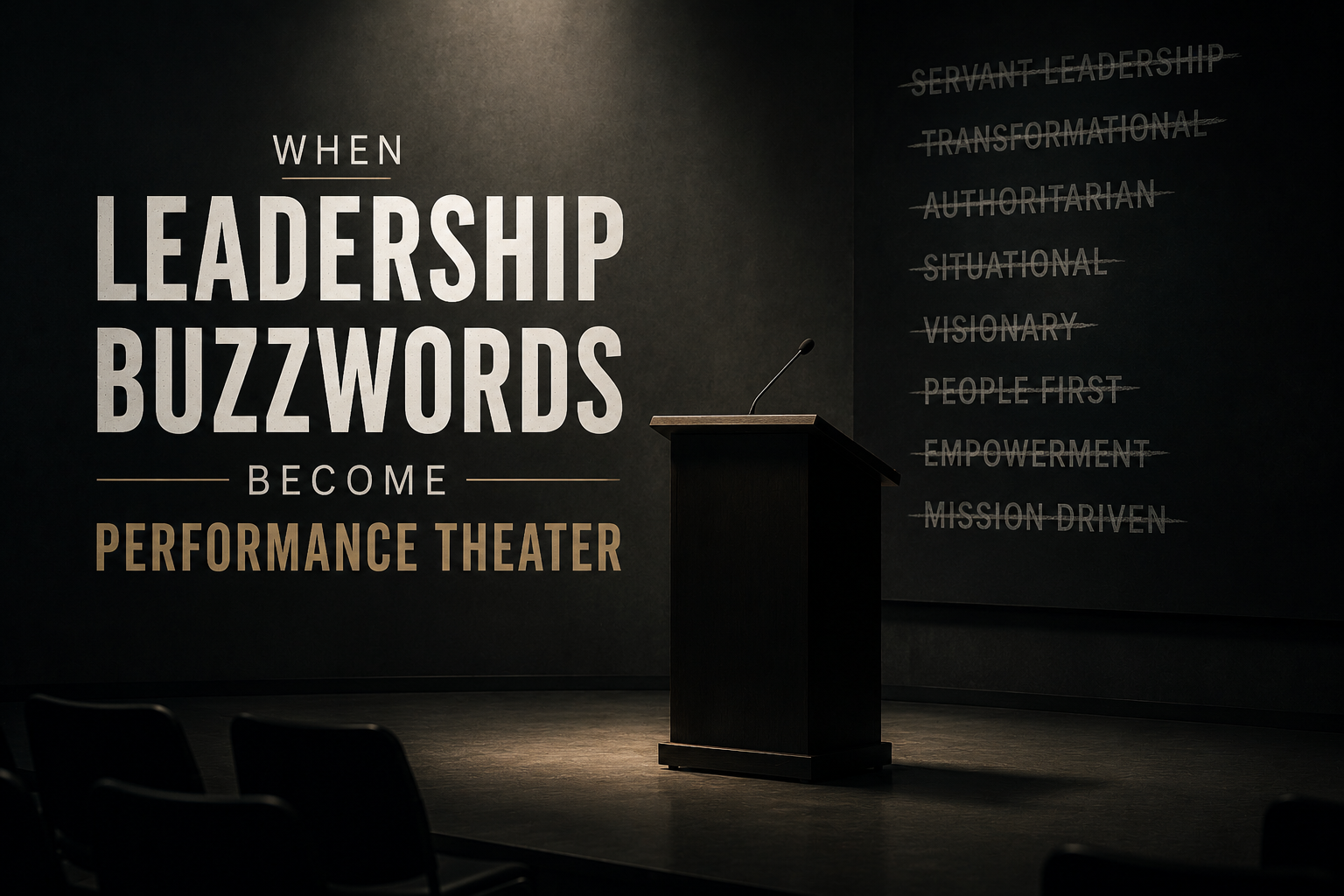
When Leadership Buzzwords Become Performance Theater
I sat on an oral board recently for a command-level position. Every single candidate described their leadership style the exact same way.
"Servant leadership," they said. One after another.
The words sounded right. They felt safe. But when I pressed them on what that actually meant, the room got quiet. Few offered anything deeper than repeating the term back to me in slightly different arrangements.
Here's what hit me: we've turned powerful leadership concepts into empty mantras we recite without understanding.
I've done it too. I've used terms I heard in a training class, concepts borrowed from books I never finished, phrases that sounded impressive but crumbled under scrutiny.
The Youngest Candidate Got It
The least experienced person in that room did something the veterans didn't. He talked about leading yourself first.
"In order to lead," he said, "you need to make sure you're leading yourself."
It was simple. Almost too simple. But it was the only answer that showed actual understanding rather than performance.
The older candidates, the ones with decades of experience, missed that connection entirely. They talked about servant leadership and then pivoted to other styles. Authoritarian. Transformational. Democratic. They name-dropped leadership theories like they were checking boxes on a form.
It gave me a glimpse of hope for the next generation. But it also revealed something about how we operate in this profession.
We think we can wing it.
We listen to trainings, hear the right terms, and assume that's enough. We take surface-level stuff and run with it. We call a buddy at another department and ask how they handled something, then we apply their half-information to our completely different situation.
It's like trying to build a house using instructions from someone who built a shed.
The Cost of Serving Without Understanding
Here's what nobody tells you about servant leadership: it can absolutely destroy you if you don't understand what it actually means.
Research backs this up. A systematic review of over 10,000 participants found that while servant leadership reduces burnout, the relationship is complex. When leaders practice it without understanding the deeper mechanisms, without boundaries or self-care, they create the exact burnout conditions they're trying to prevent.
I've lived this. I thought being a servant leader meant saying yes constantly. Protecting feelings. Being available all the time. Bending over backward to make sure everyone else was taken care of.
The result? I'd communicate something I thought was clear, but it wasn't clear to that specific person. They'd think I understood their request. I'd think they understood my boundaries. Then I'd find myself thinking, "I give them an inch and they take a mile."
But that wasn't them taking advantage. That was me failing to set clear boundaries because I thought servant leadership meant never saying no.
Communication sits at the root of everything that goes well and everything that goes horribly.
When you try to say something so carefully that you protect feelings above clarity, you create confusion. You think you're being a good leader by listening actively and crafting thoughtful responses. But sometimes clear communication is exactly what's needed to set those boundaries.
And here's the thing: when you don't understand servant leadership, you end up frustrated. You burn out. You develop compassion fatigue. You serve and serve and serve until you forget to serve yourself.
Then leadership fails entirely.
What Robert Greenleaf Actually Said
Robert K. Greenleaf coined the term "servant leadership" in 1970. He defined it with a test most leaders never ask themselves:
"Do those served grow as persons? Do they, while being served, become healthier, wiser, freer, more autonomous, more likely themselves to become servants?"
That's radically different from "I'm going to serve the people under me."
Greenleaf emphasized that servant leadership begins with "the natural feeling that one wants to serve, to serve first." Not a terminology you learned in a training class. Not a phrase you picked up from a leadership book. A genuine desire that shapes how you approach every interaction.
The cost of getting this wrong isn't just personal. Employee burnout costs U.S. employers approximately $300 billion annually. The primary predictor of preventing that burnout? "Helping subordinates grow and succeed."
Not knowing the right buzzwords. Not performing humility. Actually investing in people's growth.
The "Leaders Eat Last" Problem
I've never read Simon Sinek's book. But I've heard that phrase a thousand times in trainings.
"Leaders eat last."
So I found myself waiting. Standing there while everyone else got their food. And I know I'm not the only one. There'd be a few other leaders waiting too, and we'd do this ridiculous dance.
"Go ahead."
"No, no, you go."
"I insist."
It became this ego-based performance. I'm going to be the last one to eat because that's what good leaders do. I'm going to prove my humility by making everyone watch me be humble.
It's bullshit.
Here's what I think now: leaders should eat in the middle. Eat with your people. Sit down and break bread with them. Don't be so arrogant and pompous that you have to perform this ritual of waiting for everyone.
But be prepared. If somebody doesn't have anything to eat, give up your plate. Share your food. Make sure everyone has something.
The concept comes from the Marine Corps, where officers eat last because "the true price of leadership is the willingness to place the needs of others above your own." It works in the military because of unique team structures where you literally put your life in the hands of your team.
But we've taken a specific military metaphor and turned it into a universal law. We've made it literal when it was meant to be symbolic.
When you don't dig deep, when you don't do the research, when you just hear the words and how other people described them, you end up eating last when you should be eating in the middle.
Performance Versus Practice
I think about the difference between performing leadership and actually leading.
When people aren't well read, when they don't do their due diligence into these philosophies, they grab what sounds right and apply it everywhere.
Research on authentic leadership shows that "being a phony is hard work." Managers who struggle with inauthenticity experience depletion. They lose interest in their work. They experience low job satisfaction. It takes enormous energy to behave in ways out of sync with your true values.
The most effective authentic leaders demonstrate self-awareness first, not just vulnerability. Leaders who "establish cultures of feedback and encourage vulnerability but fail to follow through can come across as inauthentic."
Performing leadership means acting as you know. Actually leading means saying, "I don't know that answer."
Nothing makes me happier than when someone admits they don't know. It makes me want to roll up my sleeves and say, "Well, let's go find it."
The Hypervigilance Trap
I run a small police department. I care about my officers individually. I want to know them at a different level. I want to know how I can best lead them.
But sometimes you get so wrapped up in that, you create this belief that you have to be available all the time.
I've shaped this idea that I must be available because if I'm not, I'll let my people down. That's a huge burden. Many command staff and police chiefs carry it, especially in small departments with fewer layers.
We burn ourselves out just by having that thought. What if something bad happens? What if something critical happens? You have to be available. If you aren't, people will question you.
I've talked about going on vacation and having a plan to come back if something bad happened. But that's not true. There should be succession plans in place. Command staff should handle things while you're away so you can take care of yourself.
But that's not what the public expects. That's not what society has created. It often isn't fair.
You create this hypervigilance where part of your soul has to be with the agency at all times.
That's unreasonable. The department, society, the community—they won't be there with you at the end. Maybe they'll share some stories about when you were working, whether you did a nice job or a bad job. But it's a heavy price to pay.
I reflect now on whether it's worth it.
That doesn't mean servant leadership isn't worth it. It probably is. Maybe I still don't understand it completely. But using it without understanding it is dangerous if you're trying to apply it without knowing what it is.
That's where serving yourself becomes critical.
The Oxygen Mask Principle
I liken leadership to the oxygen mask on an airplane. The flight crew always says put that mask on yourself before you help anybody else. There's something to that. You may not survive if you don't get yourself straight first.
Any style of leadership that you develop or embody needs that part where you're taking care of yourself.
I've done enough work and reflection to sense when I get frustrated, when something's bothering me, when I need clearer communication. I'll apologize when I wasn't clear. I want to be better, and I want those people around me to be better.
I still struggle when people don't have the same motivation or desire to reach high levels. But I know this: you need to serve yourself first before you serve others. The philosophy is rooted in good, but without that understanding, it becomes troublesome.
Unassuming Leadership
I've always described my style as unassuming leadership. It's based on my personality. I don't need to be the center of attention. I don't need to be in the media. I don't need that stuff.
I want to focus internally. I want to focus on my team. I want to build a team that focuses on community and all the things that make the police department work.
If that's what servant leadership is, then maybe it's just different words created from who I am.
There are times now where I find myself disconnected from the work in the field. I have to go ask young officers, "Hey, how does this work now? What's changed? I haven't done these certain things."
I think that's appreciated. Young officers take that as an opportunity to showcase their skillset. Then you see what you have. Then you see who's promotable. Then you see things you might not have otherwise.
That's another little piece of it.
The "What Else?" Test
If I were sitting across from one of those oral board candidates now, I'd never want to trip them up. They're nervous. They don't know what questions are coming.
If they use terms like servant leadership, they should know what to say. And servant leadership is easy enough to talk your way around and get an acceptable answer.
But I might ask something like this:
After they've given their answer about how they would help or serve, I'd ask, "What else?"
What else is it that makes servant leadership work?
That's where you find out if someone has done the work or if they're just performing.
One thing I want more than anything is a team around me that offers new perspectives, that questions my assumptions. Many agencies look to one person or one small team to have all the answers. But all these people—small agency, big agency—they've been hired for their brains and what they have to offer.
Part of my leadership is sometimes stepping back and being a follower.
That's probably the most honest thing I can say about leadership. Sometimes the best thing you can do is get out of the way and let someone else lead. Not because you're performing humility. Because you genuinely believe they have something valuable to offer.
That's what I wish those candidates had said when they talked about servant leadership. Not the buzzword. The reality behind it.

Host | Maine Responder
I've spent much of my adult life in work that carries responsibility for other people. Along the way, I became less interested in having all the answers and more interested in asking better questions.
Maine Responder is where I work through those questions.
Through conversations, stories, and reflections, I explore leadership, human performance, purpose, and the work that shapes who we become.
I don't claim to have the answers. I'm simply curious enough to keep asking the questions.
If you'd like to think through them with me, welcome.

The Backflip Nobody Saw: What a Pop Concert Taught Me About Mastery and Drift